How Many Jobs Should I Apply to on OPT?
On OPT, the number matters only after the fit matters. A hundred weak applications do not protect your clock; a consistent system does.
Key takeaways
OPT students should set application targets by urgency, fit, market size, and tailoring capacity.
A useful week combines priority applications, standard applications, referral outreach, follow-ups, and tracking.
The right number is the highest volume you can sustain without ignoring degree relevance, location, level, or employer constraints.
There is no magic number
The honest answer is frustrating: there is no official or universal number of jobs every OPT student should apply to per day. Your target depends on remaining unemployment days, role family, geography, work authorization constraints, experience level, and how quickly you can tailor without lowering quality.
A student with 70 days left, several strong projects, and a broad set of related roles can run a different volume than a student with 15 days left and a narrow sponsor-dependent target. The number should follow the strategy, not replace it.
Use daily lanes instead of one giant quota
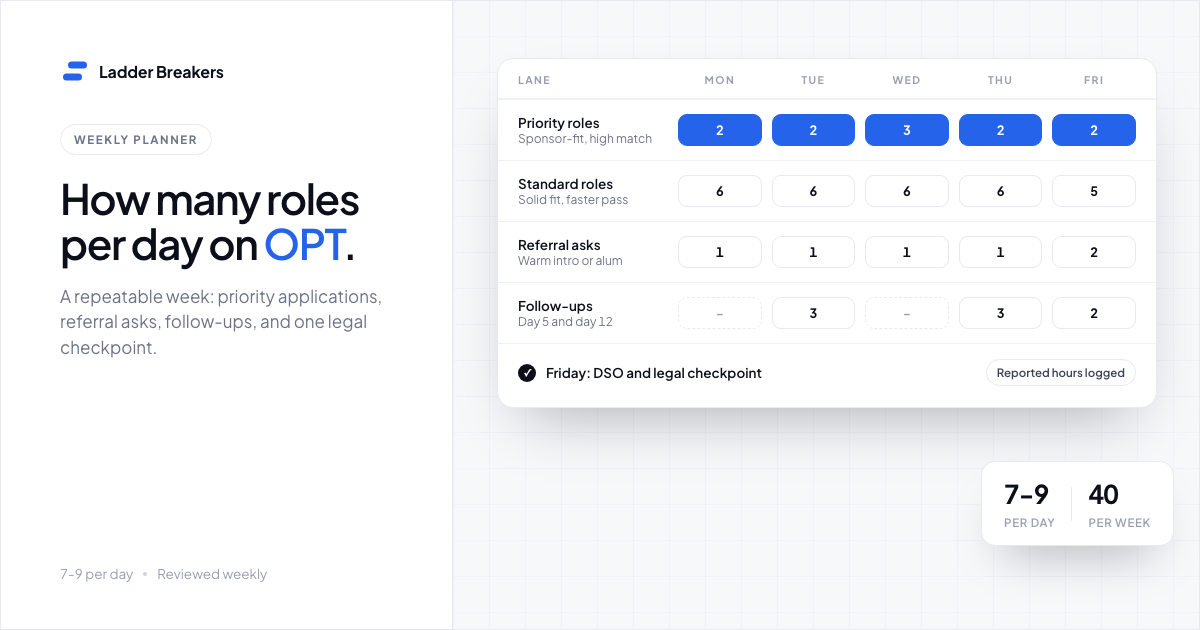
A strong OPT day can be split into lanes. Priority applications are the roles with strongest fit and realistic employer path. Standard applications are good-fit roles that can be tailored efficiently. Referral asks create trust. Follow-ups keep warm leads alive. Tracking makes the work visible.
For many active OPT searches, a practical day might mean two to five priority applications, five to fifteen standard applications, three to eight referral or recruiter messages, and a clear follow-up review. The exact range should tighten or expand based on results.
Quality still has to clear the visa-clock bar
Every counted application should pass a basic test. Is the role related to your degree and story? Is the level realistic? Is the location workable? Can your resume show real evidence? Is there any sign the employer can handle your work authorization situation now or later?
If the answer is mostly no, the application may make the spreadsheet look better while making the actual search weaker. OPT pressure makes low-quality volume tempting. That temptation is the trap.
Increase volume by improving the system
The goal is not to personally grind forever. The goal is to remove friction from repeatable steps. Keep role-family resume versions ready. Save accurate answers to common application questions. Track employer authorization notes. Reuse strong project proof. Review outcomes weekly.
This is where Ladder Breakers becomes useful: it helps create more applications by systematizing discovery, fit checks, tailoring, and tracking, instead of asking students to do every repetitive step manually at midnight.
Review the numbers every week
Do not treat your target as a moral score. Review response rate, recruiter replies, interview requests, title mix, source quality, and sponsorship signals. If there are no responses after a meaningful sample, change role targeting or resume positioning before simply increasing the quota.
The point of a number is not pressure. The point is control. A good target lets you end the day knowing the search moved in the right direction.
Related Ladder Breakers guides
FAQ
How many jobs should I apply to per day on OPT?
There is no universal number. Many active OPT searches use a mix of priority applications, standard applications, referral messages, and follow-ups. The right target is the highest consistent volume you can sustain while preserving role fit, degree relevance, and tracking.
Should OPT students prioritize quantity or quality?
OPT students need both, but quality has a floor. Applications should match the student's degree, role family, location needs, level, and employer constraints. Random volume can waste limited time.
Sources and further reading
- USCIS Policy Manual: Practical Training
- USCIS: Options for Nonimmigrant Workers Following Termination of Employment
- LinkedIn Research: Talent 2026
- LinkedIn Skills on the Rise 2026
- NACE Job Outlook 2026 Spring Update
- NACE: Demand for AI Skills in Entry-level Jobs Nearly Triples Since Fall 2025
- Google Search Central: SEO Starter Guide
- Google Search Central: Helpful, reliable, people-first content