Ladder Breakers vs. Job Search Tools: What Is Different?
Most job tools sell relief from one painful step. The real question is whether they create a complete pipeline or just make one tab less annoying.
Key takeaways
Resume scanners, trackers, autofillers, and auto-apply agents solve different parts of the search.
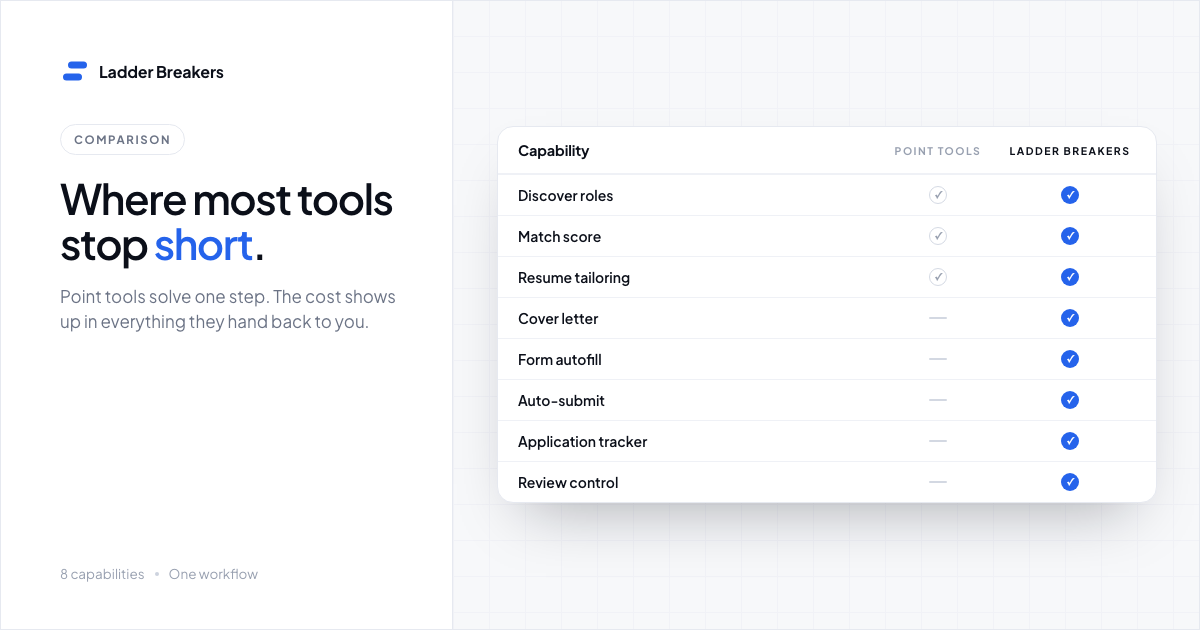
Ladder Breakers is positioned as a full application agent: matching, tailoring, submission workflow, and tracking.
The best choice depends on whether you need organization, resume scoring, faster form filling, or a continuous pipeline.
The competitor landscape
The job-search software market is crowded because the process is fragmented. Simplify focuses heavily on autofill, tailoring, and tracking through a browser extension. Teal emphasizes resume building, tailoring, and application tracking. Jobscan is known for scanning a resume against a job description and surfacing match gaps. Huntr offers a tracker, resume tools, autofill, and organization. Jobright positions around AI matching, autofill, tailored resumes, and insider connections.
These are useful categories. They also reveal the gap Ladder Breakers is trying to close: the search does not become easier just because one step is faster. You need the whole loop to move.
Where Ladder Breakers fits
Ladder Breakers is best understood as an application operating system. The product is designed to find roles, evaluate match, prepare documents, handle application workflows, and track outcomes. That makes it different from tools that stop at resume advice or tools that only fill fields after you have already found the job.
This distinction matters for candidates under time pressure. If you are on an OPT clock, an H-1B grace period, or a graduation timeline, you do not only need a cleaner resume. You need a repeatable pipeline that runs every day.
Quality control is the key difference
The word automation makes some candidates nervous because bad automation can turn a serious search into spam. Ladder Breakers should be judged by the opposite standard: does it help you submit more applications that are actually aligned? Does it preserve review control? Does it tailor materials? Does it give you an audit trail?
A strong job-search agent should make it harder to send careless applications, not easier. Volume is useful only when the system protects fit and personalization.
When another tool may be enough
If your only problem is resume keyword matching, a scanner may be enough. If your only problem is organization, a tracker may be enough. If you already know exactly where to apply and only hate repetitive forms, an autofill extension may be enough.
But if your problem is that the entire process collapses after three long nights, you probably need more than a point solution. You need a workflow that keeps generating qualified opportunities and remembers the work already done.
A practical selection rule
Choose based on the bottleneck. If you are getting interviews but failing them, buy practice, not automation. If you are applying steadily but getting no responses, fix targeting and documents. If you are barely applying because the work is too heavy, use an agent that increases qualified output.
Ladder Breakers is for the third case and often helps the second. It is not a magic offer machine. It is a way to stop letting repetitive work decide how many chances you get.