How to Get Into FAANGMULA: What It Takes Now
Big-tech offers are not reserved for people who were born knowing dynamic programming. They usually go to candidates who build proof, tell a clear story, and stay in the game long enough for luck to find them.
Key takeaways
Elite-company hiring rewards proof: projects, internships, shipped work, impact, and referrals.
Your resume must be specific enough for recruiters and keyword-aligned enough for screening systems.
The best strategy combines quality applications, referral motion, interview reps, and fast iteration.
First, define the target correctly
FAANGMULA is shorthand for the highest-signal technology companies: Facebook/Meta, Amazon, Apple, Netflix, Google, Microsoft, Uber, LinkedIn, Airbnb, and companies that hire with similar bars. The exact acronym matters less than the pattern. These companies receive enormous applicant volume, use structured interviews, and care about evidence that you can operate in a high-performance environment.
That evidence changes by level. For students, it may be internships, research, open-source work, hackathon projects, teaching assistant work, or a strong portfolio. For experienced candidates, it is shipped impact: revenue, latency, reliability, growth, cost savings, adoption, migrations, launches, and leadership.
The resume has one job: earn the conversation
A big-tech resume is not a biography. It is a proof document. Every bullet should answer three questions: what did you build, how hard was it, and what changed because of your work? A weak bullet says you worked on APIs. A strong bullet says you reduced checkout latency by 31 percent by redesigning a payment service and adding targeted caching.
Recruiters scan quickly. Screening systems also look for alignment with role language. That means one generic resume is rarely enough. Keep a base resume, then tailor a version for backend, frontend, data, ML, product, security, or infrastructure roles. The experience can be the same, but the emphasis should change.
Projects still matter, but only if they look real
A project helps when it proves taste and execution. A clone app with no users is less useful than a small tool with clean code, real deployment, logs, tests, and a clear technical write-up. Hiring teams want to see that you can finish, debug, document, and explain tradeoffs.
For students and early-career candidates, the best projects are usually narrow and deep. Build something that touches a real system: a job-alert agent, a compiler toy, a distributed queue, a data pipeline, a browser extension, a recommendation system, a mobile app with analytics, or a security scanner. Then write a short technical case study.
Referrals help, but they do not replace fit
A referral can move your resume into a better review path, but it cannot carry a vague profile. The best referral request is specific: role link, one-paragraph fit summary, resume, and a sentence explaining why that team makes sense. Do not ask strangers to guess your story for you.
Build a weekly referral habit. Reach out to alumni, former coworkers, open-source collaborators, conference speakers, and second-degree connections. Keep the ask lightweight. Make it easy for the other person to say yes.
Interview prep is a separate project
Getting an interview and passing an interview are different skills. For software roles, you need enough data structures and algorithms practice to solve under pressure, plus system design or product architecture depending on level. For product, data, design, and business roles, you need case practice, metrics fluency, and crisp storytelling.
Do not wait for the recruiter screen to begin. Treat interview prep like training for a date that can appear with little warning. The job search creates opportunity; preparation converts it.
The practical weekly operating system
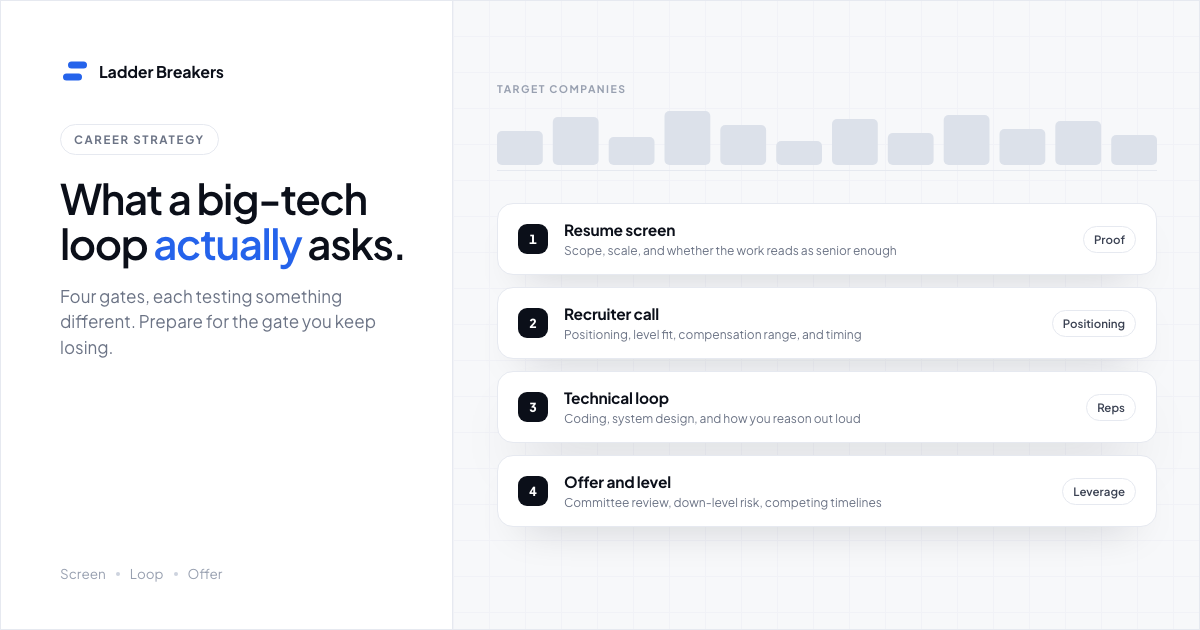
A strong weekly plan has four lanes: targeted applications, referral outreach, interview practice, and profile improvement. Applications create surface area. Referrals create trust. Practice creates conversion. Profile improvement raises your baseline.
Ladder Breakers can help with the first lane by finding and preparing targeted applications at scale. You still own the second, third, and fourth lanes. That is good news. It means the repetitive work can be systematized while your real effort moves to the leverage points.