AI Resume Tailoring: How to Beat ATS Without Lying
The goal is not to trick the ATS. The goal is to make your real fit impossible to miss.
Key takeaways
ATS optimization should align language, skills, and proof, not invent credentials.
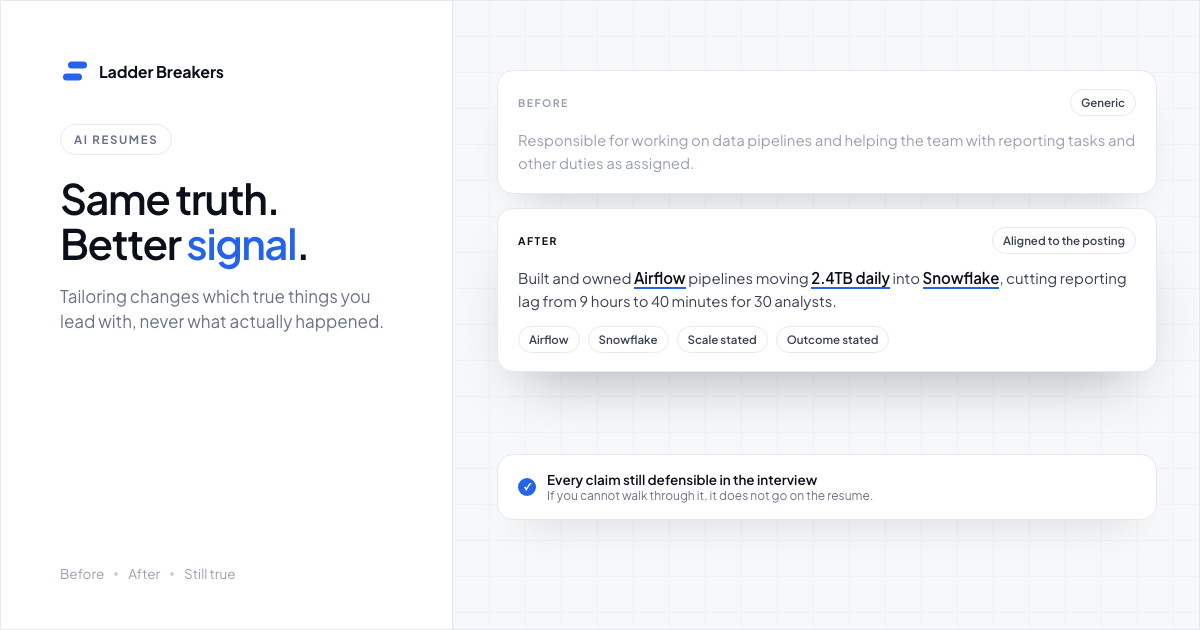
The best tailored resume keeps the same truth but changes emphasis for the target role.
AI should help with clarity, structure, and keyword mapping while the candidate owns accuracy.
What ATS tailoring really means
Applicant tracking systems help employers collect, search, sort, and review applications. Candidates often talk about "beating the ATS" as if it is a video game. That framing leads to bad behavior: keyword stuffing, fake skills, invisible text, and exaggerated job titles.
A better framing is alignment. The job description tells you what the employer is trying to recognize. Your resume should help them recognize the parts of your background that truly match.
The ethical line
You can rephrase real work. You can move relevant bullets higher. You can name tools you actually used. You can translate internal company language into industry language. You can quantify impact when you have a defensible number.
You should not claim tools you cannot use, inflate project ownership, invent metrics, rewrite job titles into false roles, or add keywords that would collapse in an interview. AI can make lying easier. That does not make lying useful.
A simple tailoring workflow
First, identify the role family: backend, data, ML, product, operations, design, security, finance, or another lane. Second, extract the core skills and responsibilities from the posting. Third, map your real evidence to those requirements. Fourth, rewrite bullets so the strongest matches are clear in the first half of the resume.
The final pass should ask: would I be comfortable defending every word in an interview? If not, cut or rewrite.
What AI is good at
AI is useful for comparing your resume against a job description, finding missing language, turning vague bullets into clearer proof, and creating alternate versions for different role families. It can also help you avoid spending an hour staring at a blank document.
AI is not good at knowing what actually happened in your work. You are the source of truth. Treat AI output as a draft, not a confession.
What recruiters still need
Recruiters need clarity fast. They need to know your role, level, relevant skills, scope, and whether the match is worth a screen. Hiring managers need deeper proof: how you think, what you owned, what tradeoffs you made, and whether your claimed skills hold up.
A tailored resume should satisfy both. It should be keyword-aware enough to be found and human enough to be believed.
Related Ladder Breakers guides
FAQ
Can AI resume tailoring hurt me?
Yes, if it invents skills, exaggerates ownership, or adds claims you cannot defend. Used well, AI tailoring clarifies your real fit and aligns your language with the job description.
Is ATS optimization the same as keyword stuffing?
No. Good ATS optimization maps real experience to the employer's language. Keyword stuffing repeats terms without proof and creates a worse experience for recruiters and hiring managers.
Sources and further reading
- LinkedIn Research: Talent 2026
- LinkedIn Skills on the Rise 2026
- NACE Job Outlook 2026 Spring Update
- NACE: Demand for AI Skills in Entry-level Jobs Nearly Triples Since Fall 2025
- Simplify Copilot
- Teal
- Jobscan Resume Scanner
- Huntr Help Center: What is Huntr?
- Jobright
- Google Search Central: SEO Starter Guide
- Google Search Central: Helpful, reliable, people-first content