New Grad Resume Strategies: What to Add and How to Get Noticed
A new-grad resume is not supposed to prove you have ten years of experience. It is supposed to prove you can learn fast, solve real problems, and become useful quickly.
Key takeaways
New grads get noticed by showing role-aligned proof, not by pretending to have senior experience.
The strongest resumes translate projects, internships, campus work, research, and part-time jobs into evidence of problem solving.
Ladder Breakers helps new grads tailor resumes for each role and apply consistently without losing quality.
The resume has one job
Your resume does not need to tell your whole life story. It needs to create enough trust for a recruiter or hiring manager to say, this person is worth a conversation. That is it. A resume is not an autobiography. It is a signal document.
For new grads, the signal is different from experienced candidates. You are not trying to prove long tenure or massive ownership. You are trying to prove learning speed, problem solving, communication, technical foundation, judgment, and evidence that you have already done work similar to the role.
What employers actually scan for
NACE employer research repeatedly points to practical career-readiness skills: problem solving, teamwork, written communication, initiative, work ethic, technical skills, verbal communication, adaptability, and analytical thinking. In 2026, employers are also paying closer attention to AI fluency and whether students can use modern tools responsibly.
This means your resume should not read like a school transcript with bullet points. It should read like proof that you can operate in a workplace: understand a problem, choose a tool, work with people, produce an outcome, and explain what changed because of your work.
Start with role families
Before editing your resume, choose two or three role families. A role family is a cluster of jobs that use similar proof. For example: software engineer, backend engineer, and developer tools engineer. Or data analyst, business analyst, and product analyst. Or marketing coordinator, growth associate, and content strategist.
This matters because a resume for every job becomes a resume for no job. The skills, project order, keywords, and bullet emphasis should change depending on the role family. One base resume can support several versions, but each version needs a clear target.
What to add if you do not have much experience
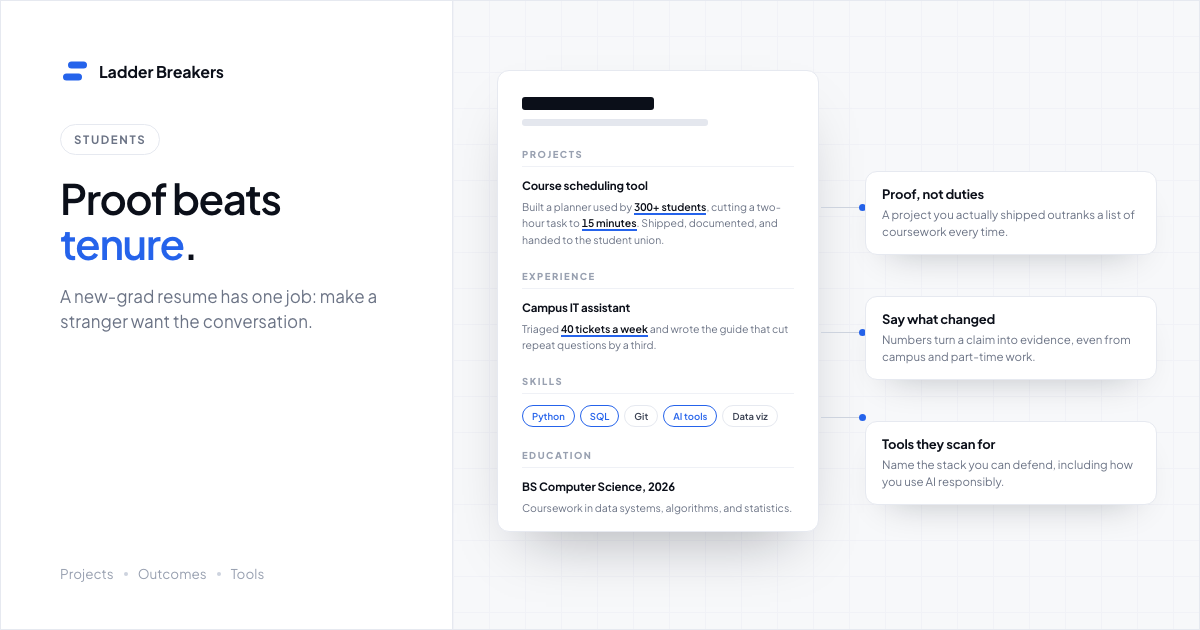
Add projects that look like work. A project is stronger when it has users, data, constraints, a live demo, a GitHub repo, a dashboard, a design case study, a report, or a measurable result. Class projects count if they are framed around the problem and outcome, not just the course name.
Add internships, research, campus jobs, part-time work, volunteer roles, hackathons, open-source contributions, club leadership, tutoring, freelance work, family-business responsibilities, and self-directed builds. The question is not whether the experience sounds fancy. The question is whether it proves a skill the employer needs.
Use bullets that prove action and outcome
Weak bullets describe duties: worked on a website, helped with data, assisted team members, participated in meetings. Strong bullets show action, tools, scope, and outcome: built a React dashboard for 200 student users, cleaned 50,000 rows of survey data in Python, reduced manual club scheduling work by 6 hours per week, or wrote onboarding docs used by 30 volunteers.
Use this formula: action verb, object, method or tool, result. If you do not have a hard metric, use a truthful scope marker: number of users, records, pages, tests, teammates, customers, events, tickets, experiments, or weeks. Specific beats inflated every time.
Make skills easy to believe
A skills section helps with scanning, but skills without evidence are fragile. If you list Python, SQL, Excel, Figma, React, Salesforce, Tableau, AWS, or AI tools, the reader should find a bullet somewhere that proves you used them. Otherwise the skills section feels like a keyword pile.
For AI skills, be especially clear. Do not just write AI or ChatGPT. Show the workflow: used AI to draft test cases, compare resume/job-description fit, summarize user interviews, create spreadsheet formulas, prototype customer support macros, or generate first-pass SQL explanations that you verified. Responsible use is stronger than vague hype.
Put the strongest evidence high
Recruiters scan quickly. Do not bury the best proof on page two or under a generic coursework section. If your strongest evidence is a project, put projects near the top. If your strongest evidence is an internship, lead with experience. If your strongest evidence is research, make research readable to a non-academic hiring manager.
A new-grad resume should usually be one page unless there is a real reason to expand. The goal is not to include everything. The goal is to make the top half of the page impossible to dismiss.
How to get noticed beyond the resume
Getting noticed is not only a formatting problem. LinkedIn’s 2026 grad research found that many Gen Z job seekers see lack of network as a major barrier to entry-level roles. That does not mean you need a famous family friend. It means you need visible signals outside the application: referrals, alumni messages, project links, GitHub, portfolio, LinkedIn posts, short case studies, and warm introductions.
The best version is simple: apply with a tailored resume, then create one human signal around the same role. Message an alum. Comment thoughtfully on a team member’s post. Send a short project link. Ask a specific question. The goal is not to beg. The goal is to make your application easier to recognize.
Avoid the new-grad resume traps
Do not lead with an objective statement that says you are seeking an entry-level role where you can grow. Everyone knows that. Use the space for proof. Do not stuff every technology you have touched for ten minutes. Do not list coursework without translating it into skills. Do not hide work authorization or location constraints if they are central to the search strategy.
Also avoid copying senior resume language. New grads often weaken trust by making small projects sound like enterprise ownership. Recruiters can smell the costume. Be ambitious, but be precise. A truthful, specific bullet beats a dramatic vague one.
How Ladder Breakers helps new grads stand out
Ladder Breakers helps new grads do the hard part at scale: match roles, tailor resumes, generate role-specific cover letters, and keep the pipeline moving. That matters because most new grads either send generic applications or burn out trying to manually tailor every resume from scratch.
The product is built for the middle path: high-quality volume. You still need real proof. You still need interview preparation. You still need projects and clear stories. But Ladder Breakers helps make sure your proof is aimed at the right roles and presented in the language each employer is already using.
The resume should make hope operational
Hope is not sitting with one perfect resume and waiting. Hope is a weekly system: improve proof, tailor for the right role family, send enough high-fit applications, create human signals, review response rates, and adjust.
For new grads, that system is how the first real opportunity starts to feel possible. Not because the market becomes easy, but because your effort becomes organized enough to compound.
Related Ladder Breakers guides
FAQ
What should new grads put on a resume with little experience?
New grads should include internships, projects, research, campus work, part-time jobs, volunteer work, leadership, hackathons, coursework with real outputs, technical skills, and measurable outcomes. The goal is to prove role-aligned ability, not senior-level experience.
How can a new-grad resume get noticed?
A new-grad resume gets noticed when the top half clearly matches the role family, shows specific proof, uses relevant keywords honestly, links to visible work, and turns vague duties into action-and-outcome bullets.
Should new grads tailor their resume for every job?
Yes, but tailoring should be controlled. New grads should build role-family resume versions and adjust emphasis for each job description instead of rewriting from scratch or sending the same generic resume everywhere.
Sources and further reading
- NACE: What Are Employers Looking for When Reviewing College Students’ Resumes?
- NACE: Career Readiness Defined
- NACE: Employers Say New Grads Are Largely Prepared for Work, With Room to Improve
- LinkedIn: How Graduates Can Find the Best Job Opportunities in 2026
- LinkedIn: The Fastest-Growing Skills That Pay Off for Professionals
- LinkedIn Research: Talent 2026
- LinkedIn Skills on the Rise 2026
- NACE Job Outlook 2026 Spring Update
- NACE: Demand for AI Skills in Entry-level Jobs Nearly Triples Since Fall 2025
- Google Search Central: SEO Starter Guide
- Google Search Central: Helpful, reliable, people-first content