Your First Job After Graduation Matters More Than You Think
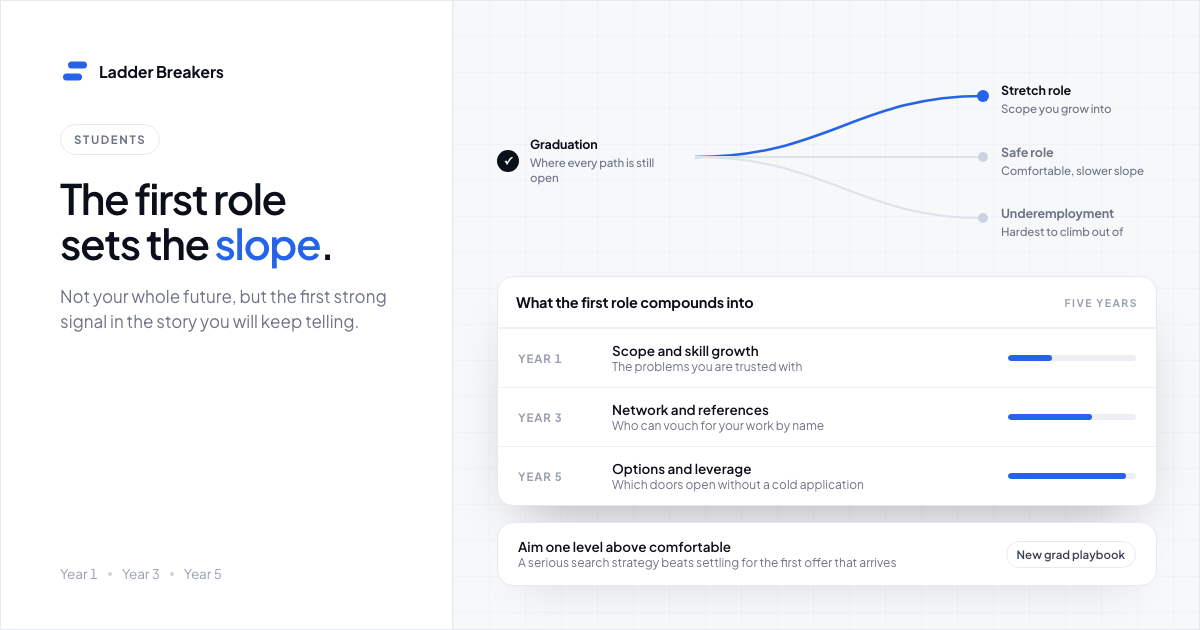
Your first job is not your entire future. But it can become the first strong signal in your career story, and that signal deserves a serious search strategy.
Key takeaways
The first job after graduation matters because it creates early proof, network, skill loops, and future interview stories.
It is not destiny: new grads can recover, pivot, and grow, but a stronger first role makes the next move easier.
Ladder Breakers helps new grads compete for better first roles by finding fresh jobs, tailoring applications, and keeping the pipeline moving.
The first job is a launchpad, not a life sentence
New grads feel the weight of the first job because the first job feels like proof. Proof that college worked. Proof that the resume is real. Proof that the next chapter has started. That pressure is understandable, but it needs a calmer frame.
Your first job does not decide your whole life. Plenty of people start in messy roles, switch lanes, find better managers, learn faster somewhere else, or rebuild their path after a slow beginning. The danger is not a less-than-perfect first job. The danger is treating the first job search casually when it has compounding effects.
Why the first role has so much gravity
The first role after graduation shapes the stories you tell in the next interview. It determines what tools you use, what problems you touch, what managers can vouch for you, and what future recruiters assume you are ready to do. A strong first role gives you evidence. Evidence becomes confidence. Confidence becomes better interviews. Better interviews create better options.
Research on early-career labor markets supports that intuition. The New York Fed has continued to track elevated unemployment and high underemployment among recent college graduates, and NBER research has found that the immediate post-college job transition strongly predicts earnings several years later. Translation for students: the first step matters because it changes the slope of the next few steps.
A good first job gives you four assets
The first asset is skill growth. You want work that forces you to solve real problems, not only perform repetitive tasks. The second is credibility. A recognizable company helps, but credible work matters more: shipped features, handled customers, analyzed revenue, improved operations, supported production, launched campaigns, or built systems people used.
The third asset is mentorship. A manager or senior teammate who teaches you how high-quality work is done can change your speed for years. The fourth is optionality. A good first job does not trap you in one title. It gives you adjacent paths: analyst to product, support engineer to solutions engineer, backend engineer to platform, operations to growth, intern-style generalist to focused specialist.
What new grads should optimize for
Optimize for role-family fit before brand. A famous company in the wrong lane may teach less than a strong team in the right lane. Optimize for learning rate before comfort. The first year should stretch you, but not break you. Optimize for proof. If the job will let you point to outcomes six months later, it is more valuable than a vague title with no evidence.
Also optimize for market visibility. Some roles translate cleanly to the next opportunity because recruiters understand them. Others require more explanation. That does not make them bad, but it means you need to be deliberate about how the role builds your next story.
The mistake is waiting for the perfect opening
Many new grads swing between two bad modes. In one mode, they apply to everything and slowly stop believing in themselves. In the other, they wait for perfect roles, perfect resumes, perfect referrals, and perfect timing. The market does not reward either extreme.
The better path is high-quality volume. You need enough applications to create chances, and enough tailoring that each chance has a reason to work. You need a system that can search broadly while still protecting your role-family focus.
How Ladder Breakers helps new grads get a better first shot
Ladder Breakers helps new grads by turning the search into an operating system. It finds fresh roles across company career pages, scores them against your profile, prepares tailored materials, and keeps applications moving instead of letting the search depend on one exhausted student refreshing job boards at midnight.
For a new grad, that matters because the best first job is often not the one everyone saw on the same platform. It may be a role posted directly on a company site. It may be a small team hiring quietly. It may be a job where your project, internship, research, campus work, or international background lines up better than your resume template currently shows.
How to use the first job search to build hope
Hope is not pretending the market is easy. The 2026 entry-level market is mixed: NACE projects growth in new graduate hiring, but also notes uneven demand, skills-based hiring, AI expectations, and a fair-not-easy environment. Hope is building a system that gives your effort more surface area.
A strong system says: here are the roles worth chasing, here is the resume version for each lane, here is what went out, here is what came back, here is what we change next week. That is how you protect morale. Not by waiting for luck, but by increasing the number of serious opportunities where luck can meet preparation.
The goal is the best available start
New grads do not need a perfect first job. They need a first job that helps them become more hireable, more skilled, more confident, and more visible. The best first job gives you proof you can carry into the next room.
That is what Ladder Breakers is built to help with: more fresh roles, better matching, better tailoring, consistent applications, and a calmer pipeline. The point is not just to get hired. The point is to give your future self a stronger beginning.
Related Ladder Breakers guides
FAQ
Does your first job after graduation decide your whole career?
No. Your first job is not destiny, but it can shape early skills, proof, network, confidence, and future interview stories. A stronger first role often makes the next role easier to win.
What should new grads look for in a first job?
Look for role-family fit, real skill growth, credible work, mentorship, marketable tools, and evidence you can show in the next interview. Brand helps, but useful proof matters more.
How can Ladder Breakers help new grads find a better first job?
Ladder Breakers finds fresh roles, scores fit, tailors resumes and cover letters, and keeps a tracked application pipeline running so new grads can create more high-quality chances.
Sources and further reading
- Federal Reserve Bank of New York: The Labor Market for Recent College Graduates
- NACE: First Destinations for the College Class of 2024
- NBER: Who Rides Out the Storm? The Immediate Post-College Transition and its Role in Socioeconomic Earnings Gaps
- American Economic Association: The Short- and Long-Term Career Effects of Graduating in a Recession
- Federal Reserve Bank of St. Louis: The Jobs and Degrees Underemployed College Graduates Have
- LinkedIn Research: Talent 2026
- LinkedIn Skills on the Rise 2026
- NACE Job Outlook 2026 Spring Update
- NACE: Demand for AI Skills in Entry-level Jobs Nearly Triples Since Fall 2025
- Google Search Central: SEO Starter Guide
- Google Search Central: Helpful, reliable, people-first content