A Must-Have Job Search System for Students on the OPT Timer
OPT does not give you unlimited emotional runway. A system gives you back the one thing the timer tries to take: control.
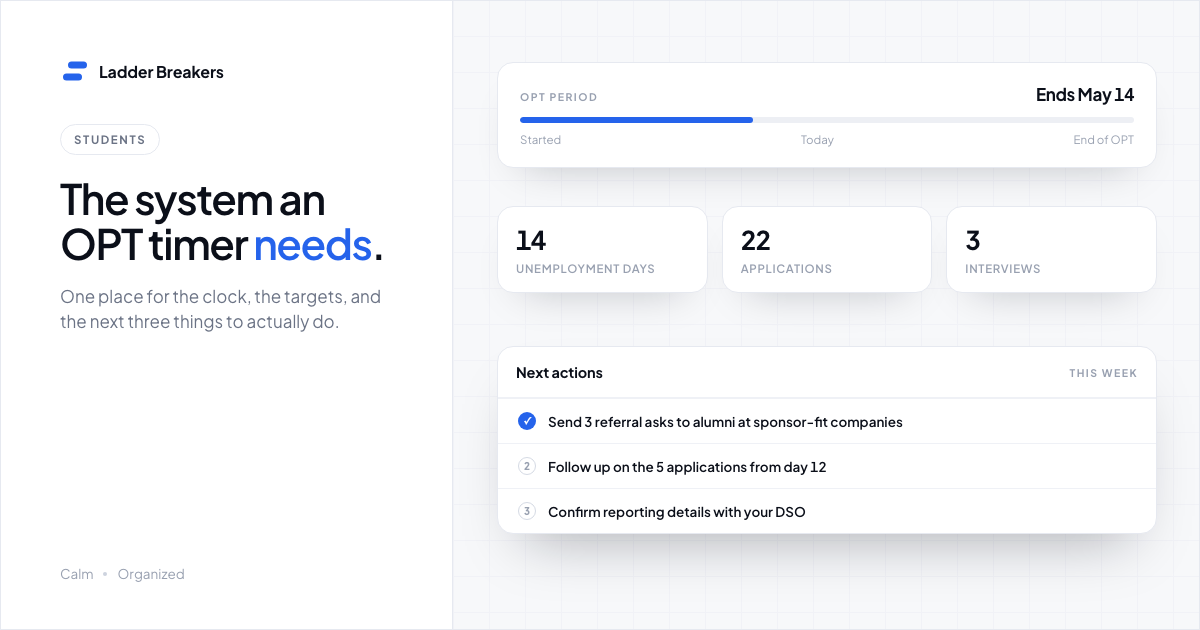
Key takeaways
USCIS says post-completion OPT students may not accrue more than 90 aggregate days of unemployment; STEM OPT has a 150-day aggregate limit across OPT and STEM OPT.
Students should start before the timer feels urgent, with target roles, tailored resumes, referrals, and weekly metrics.
The goal is not random volume. It is consistent, documented, role-aligned activity.
The timer changes the search
For many international students, graduation is not the finish line. It is the start of a regulated job-search window. USCIS guidance says F-1 students on post-completion OPT may not accrue more than 90 aggregate days of unemployment, and STEM OPT students may not accrue more than 150 aggregate days across the total OPT period. Always confirm your exact situation with your DSO or an immigration professional.
That clock changes how you should operate. A casual search is risky. A spreadsheet you update once a week is not enough. You need a daily system.
What the system needs
A serious OPT job-search system has five parts: a target list, a tailored resume workflow, an application agent, referral outreach, and evidence tracking. The target list keeps you focused. Tailoring improves fit. The application agent creates consistency. Referrals increase trust. Tracking protects your memory and helps you adjust.
Most students over-index on one part. They either apply everywhere with the same resume or spend five hours perfecting one application. Neither extreme is kind to the timer.
Start with roles that match the degree and story
Your work must fit the rules that apply to your status and training plan. From a career perspective, it also needs to fit your story. The tighter the connection between degree, skills, project proof, and target role, the easier it is for employers to understand you quickly.
Create three tiers of target roles: dream roles, strong-fit roles, and bridge roles. Dream roles stretch you. Strong-fit roles match your current proof. Bridge roles keep you moving and may create experience that opens the next door.
Make weekly output visible
Hope disappears when the search becomes a fog. Track applications, tailored resumes, referrals sent, recruiter conversations, interviews, rejections, and follow-ups. The point is not to punish yourself with metrics. The point is to see whether the system is producing enough opportunity.
A simple weekly review can change everything: Which titles responded? Which resumes worked? Which companies sponsor? Which locations moved faster? What should stop next week?
Use automation carefully
Students on a timer need leverage, but careless auto-apply can be dangerous. You do not want hundreds of weak applications that do not fit your degree, authorization, location, or role goals. Automation should make quality repeatable.
That is the Ladder Breakers angle: increase the number of serious attempts while preserving targeting, tailoring, and tracking.
Related Ladder Breakers guides
FAQ
How should OPT students organize the job search?
Use a daily system: target roles that fit your degree and story, tailor resumes, apply consistently, track evidence of activity, send referrals, and review weekly outcomes.
Should OPT students apply everywhere?
No. OPT students need consistent output, but applications should still match role, degree relevance, location, authorization constraints, and realistic employer fit.