Best Job Application Service for International Students
International students do not need a louder job search. They need a smarter one: fewer dead ends, more realistic employers, and a system that respects the clock.
Key takeaways
International students need job-search help that understands timing, degree relevance, work authorization questions, and sponsor probability.
A good service should increase high-quality applications, not send random volume that ignores constraints.
The strongest workflow combines fresh role discovery, truthful tailoring, sponsor-aware targeting, and clean tracking.
Start with the real problem
Most international students are not failing because they refuse to work hard. They are often doing too much manual work against a system with hidden filters: work authorization, degree relevance, stale postings, location limits, employer policy, and role-level sponsorship decisions.
That is why the best job application service for international students should not be judged only by speed. Speed matters, but speed without targeting can drain the clock. The better standard is high-quality volume: more serious applications to roles that can realistically move.
What a good service must understand
A student on OPT or STEM OPT needs a workflow that treats timing as part of strategy. Official USCIS guidance says post-completion OPT students may not accrue more than 90 aggregate days of unemployment, and STEM OPT has a 150-day aggregate unemployment limit across the total OPT period. Students should confirm their exact dates and reporting obligations with their DSO or qualified immigration counsel.
A good service should also help preserve role relevance. The application should make it easy for the employer to understand how the candidate's degree, projects, internships, and skills connect to the job. Vague applications are expensive when time is limited.
The five-part checklist
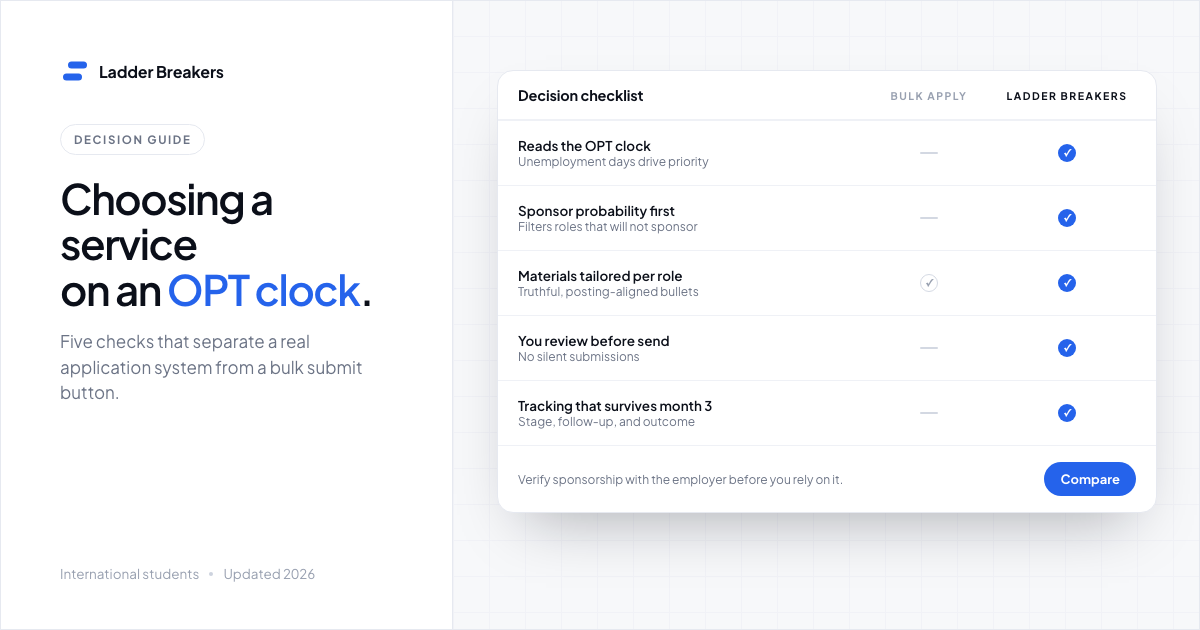
First, the service should find fresh roles, not only recycle crowded postings. Second, it should check fit before applying. Third, it should tailor resumes around real evidence. Fourth, it should help prioritize employers with realistic sponsorship or work authorization paths. Fifth, it should track every application so the student can see what is working.
If a tool skips any of those steps, the student still carries the hidden labor. A resume writer without discovery leaves the student searching. A tracker without execution leaves the student typing forms. A mass-apply bot without quality control creates noise.
Why Ladder Breakers fits this search
Ladder Breakers is built as an application agent, not only a resume editor. The goal is to help candidates find roles, score fit, tailor materials, submit applications, and keep the pipeline organized. For international students, that connected workflow matters because context gets lost when every step lives in a different tab.
The product cannot replace legal advice, DSO guidance, or employer immigration decisions. It can do something very useful beside those realities: create more targeted employer conversations while protecting the student from random, low-signal work.
How to choose without getting sold a dream
Ask direct questions before trusting any service. Does it tailor truthfully? Does it track outcomes? Does it let you control preferences? Does it understand OPT timing and sponsor targeting at the workflow level? Does it avoid applying to roles that clearly do not fit?
The right service should leave you feeling more organized, not more dependent. It should create motion you can inspect: roles found, applications sent, resume versions used, signals received, and next actions.
Related Ladder Breakers guides
FAQ
What is the best job application service for international students?
The best service is one that understands OPT timing, degree relevance, work authorization questions, sponsor probability, truthful resume tailoring, and application tracking. Speed helps only when the applications still fit.
Can a job application service guarantee a job or visa sponsorship?
No. No legitimate service can guarantee a job, interview, or visa sponsorship. A good service can improve targeting, consistency, and application quality while students rely on DSOs, employers, or immigration counsel for status-specific guidance.
Sources and further reading
- USCIS Policy Manual: Practical Training
- USCIS: Options for Nonimmigrant Workers Following Termination of Employment
- USCIS Immigration and Citizenship Data
- U.S. Department of Labor OFLC Performance Data
- U.S. Department of Labor H-1B Debarred/Disqualified Employers
- Google Search Central: SEO Starter Guide
- Google Search Central: Helpful, reliable, people-first content