The H-1B Sponsorship Job Search Checklist
When you need sponsorship, fit is not only skills and salary. Fit also means the employer can say yes to the immigration path.
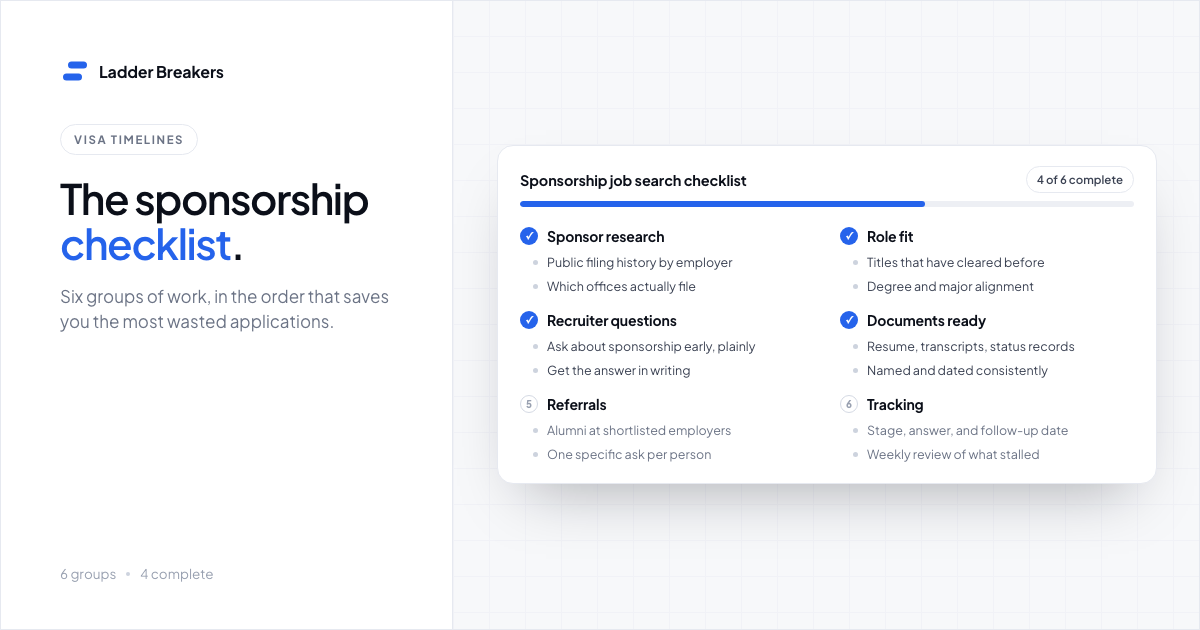
Key takeaways
Past sponsorship is a useful signal, not a guarantee for a specific role or team.
Candidates should combine public sponsor data, recruiter verification, referrals, and role-fit evidence.
A sponsorship-aware search protects time by prioritizing employers that can realistically proceed.
Check sponsor history before you invest heavily
Use official USCIS and Department of Labor data to understand whether an employer has sponsored workers before. Historical data does not guarantee future sponsorship, but it helps you separate possible employers from employers that may have no process at all.
Look for patterns: job titles, locations, departments, and repeated filings. A company that sponsored senior research scientists in one location may not sponsor entry-level analysts in another. Treat the data as evidence to investigate, not a promise.
Verify the role, not just the company
A company can sponsor and still decline sponsorship for a specific job. Budget, level, team, location, timing, and internal policy can all change the answer. Ask recruiters directly and professionally once there is enough mutual interest.
A useful question is: "Does this role support current or future H-1B sponsorship for qualified candidates?" That keeps the conversation role-specific and avoids vague optimism.
Build a sponsor-first target list
Your daily pipeline should separate sponsor-likely, sponsor-unknown, and sponsor-unlikely roles. The sponsor-likely lane gets the most tailoring and referral effort. Sponsor-unknown roles get quick verification. Sponsor-unlikely roles should not consume your best energy unless there is another strong reason.
This is not about lowering ambition. It is about making sure your ambition is pointed at doors that can actually open.
Make the business case easy
Sponsorship adds process for the employer. Your application has to make the value obvious. Show measurable impact, role alignment, scarce skills, domain knowledge, and communication strength. If the employer has to do extra work, your fit should be easy to defend.
That is why generic resumes are costly for sponsorship candidates. They hide the strongest argument for taking the process seriously.
Track every sponsorship signal
Track whether sponsorship is stated on the posting, confirmed by recruiter, mentioned by an employee, inferred from history, or unknown. Add dates and notes. Over time, this becomes a map of where your effort is producing real conversations.
Ladder Breakers is built to help candidates turn this kind of constraint into a working pipeline: not by pretending the constraint is easy, but by making each application more intentional.
Related Ladder Breakers guides
FAQ
How do I know if a company sponsors H-1B?
Use official USCIS and Department of Labor data as a starting signal, then verify the specific role with recruiters or company contacts. Past sponsorship does not guarantee sponsorship for every role.
When should I ask about H-1B sponsorship?
Ask once there is enough mutual interest or when the application specifically asks about work authorization. Keep the question role-specific and professional.
Sources and further reading
- USCIS Immigration and Citizenship Data
- U.S. Department of Labor OFLC Performance Data
- U.S. Department of Labor H-1B Debarred/Disqualified Employers
- USCIS Policy Manual: Practical Training
- USCIS: Options for Nonimmigrant Workers Following Termination of Employment
- Google Search Central: SEO Starter Guide
- Google Search Central: Helpful, reliable, people-first content