How Software Engineers Can Find H-1B Sponsoring Companies
For software engineers who need H-1B sponsorship, the best job search starts before the application: with companies that can realistically move.
Key takeaways
Software engineers should combine sponsor history with role-family fit, location, level, tech stack, and recruiter confirmation.
Official USCIS and Department of Labor data can reveal historical employer activity, but not a guarantee for a specific job.
Technical proof matters more when sponsorship adds process for the employer.
Start with sponsor probability
If you need H-1B sponsorship or transfer support, every application has two fit questions. First: can you do the engineering work? Second: can this employer and this role support the immigration process you need? Ignoring the second question wastes the first.
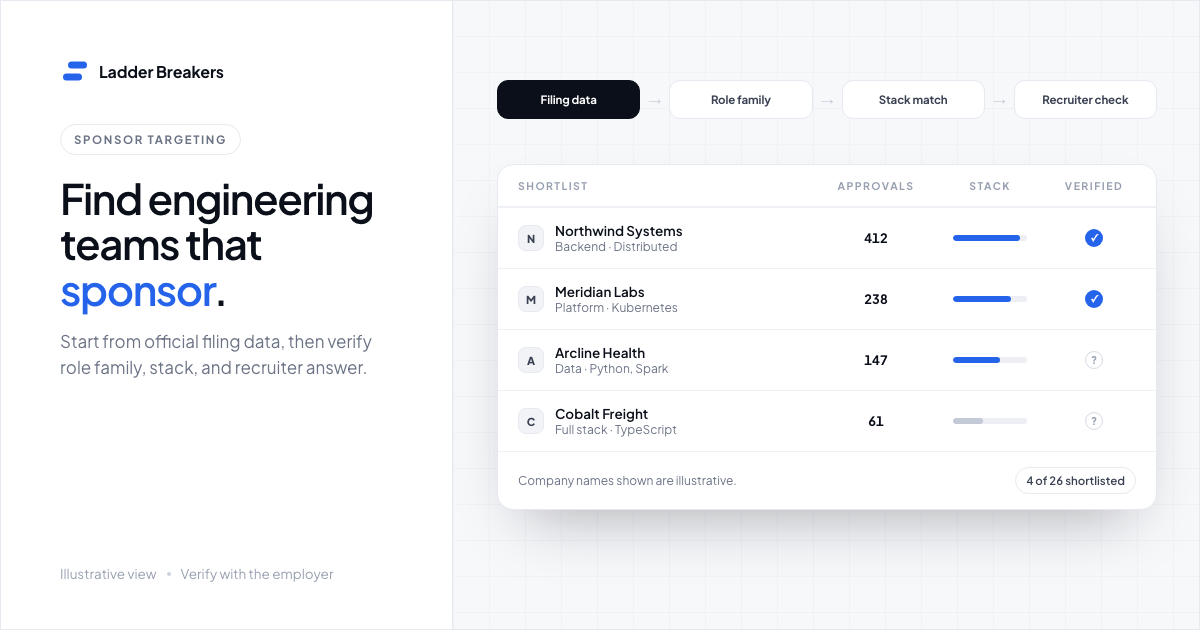
USCIS employer data and Department of Labor foreign labor data can help you identify companies with historical H-1B activity. Use that data to build a target list, then verify the current role with recruiters or company contacts.
Filter by engineering role family
Software engineering is not one market. Backend, frontend, full-stack, platform, infrastructure, ML, data engineering, security, mobile, and developer tools roles can have different teams, budgets, locations, and sponsorship patterns. A company that sponsors ML infrastructure engineers may not sponsor every entry-level web role.
Build sponsor lists by role family. Track which companies have hired people close to your target title, level, location, and stack. The tighter the match, the stronger the signal.
Make technical proof easy to defend
Sponsorship adds administrative work for the employer, so your value needs to be obvious. Your resume should show systems built, scale handled, bugs fixed, latency reduced, developer productivity improved, model performance increased, incidents resolved, or products shipped.
If you are early career, proof can come from internships, research, open source, serious projects, or production-like deployments. Avoid fluffy project descriptions. Show architecture, constraints, tradeoffs, tests, users, metrics, or demos.
Ask the sponsorship question cleanly
Do not bury the question, and do not lead with fear. A clean message is role-specific: "I am interested in this backend engineer role because my recent work with distributed services maps closely to the requirements. Can you confirm whether this team can support H-1B transfer or sponsorship for qualified candidates?"
If the answer is no, remove the role from the serious lane unless there is another strategic reason. A sponsor-aware search protects time by closing dead ends quickly.
Use a pipeline, not a list
A static list of sponsor companies is only a starting point. Convert it into a pipeline: company researched, role found, sponsor signal checked, resume tailored, applied, referral requested, recruiter contacted, response logged, next action scheduled.
Ladder Breakers can help software engineers keep that pipeline moving by pairing application volume with fit checks and tailored technical evidence.
Related Ladder Breakers guides
FAQ
How can software engineers find H-1B sponsoring companies?
Start with official USCIS and Department of Labor data to find employers with historical H-1B activity. Then filter by engineering role family, location, level, tech stack, and recruiter confirmation for the specific role.
Does a company sponsor every software engineering role if it has sponsored before?
No. Sponsorship can vary by role, team, level, location, budget, and timing. Historical sponsorship is a signal to investigate, not a guarantee.
Sources and further reading
- USCIS Immigration and Citizenship Data
- U.S. Department of Labor OFLC Performance Data
- U.S. Department of Labor H-1B Debarred/Disqualified Employers
- USCIS Policy Manual: Practical Training
- USCIS: Options for Nonimmigrant Workers Following Termination of Employment
- World Economic Forum: Future of Jobs Report 2025
- NACE Job Outlook 2025
- Google Search Central: SEO Starter Guide
- Google Search Central: Helpful, reliable, people-first content