How AI Is Changing the Job Market
The AI job market is not a simple story of replacement. It is a story of reshuffling, and reshuffling rewards people who move before they are forced to.
Key takeaways
AI is expected to reshape tasks and skills across industries, not only tech jobs.
Technical skills are rising, but human skills like judgment, resilience, and communication remain critical.
Candidates should update skills, documents, and search strategy at the same time.
The market is changing at the task level
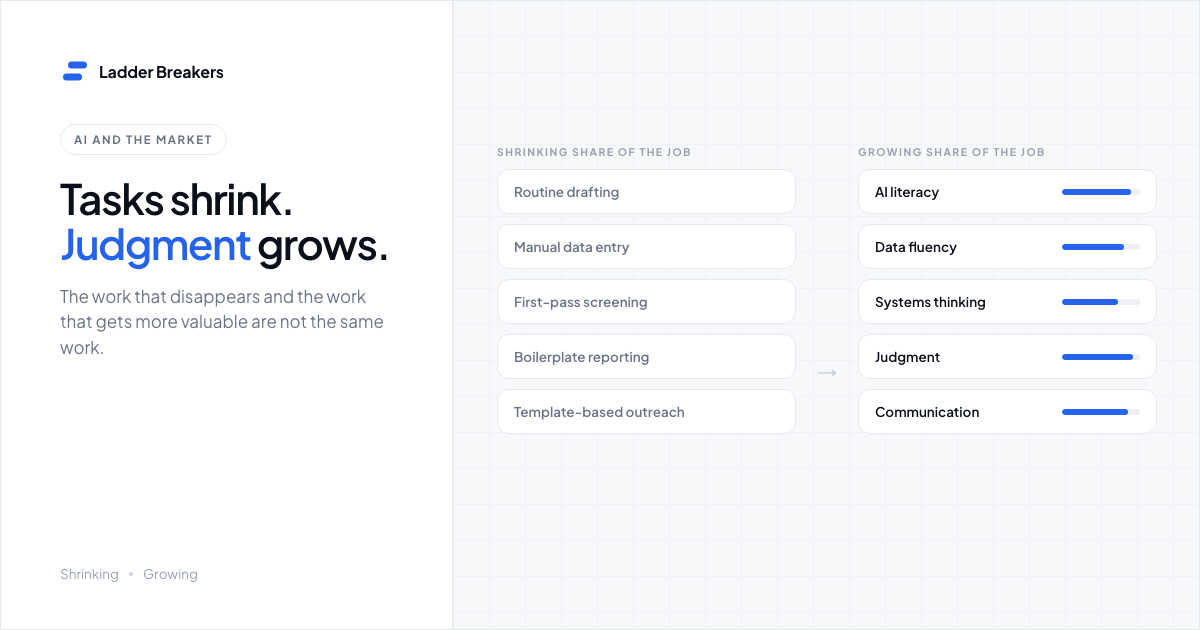
AI does not replace entire careers all at once. It usually changes tasks first. Writing first drafts, summarizing documents, generating code scaffolds, searching knowledge bases, creating reports, and handling routine support are all easier to automate or augment. When tasks change, job descriptions change.
That means candidates should read job postings differently. Do not only look at title and salary. Look at the tools, workflows, and decision rights. Ask: what part of this role is being automated, and what part still needs judgment?
The skills bar is moving
The World Economic Forum expects significant skill disruption by 2030, with technology skills rising quickly alongside human skills such as analytical thinking, resilience, flexibility, leadership, and collaboration. That combination is important. The future is not just prompt engineering. It is knowing what to ask, what to trust, and what to do when the output is wrong.
For students and early-career candidates, AI literacy is becoming table stakes. You do not need to be an ML researcher for every job, but you should know how AI fits into your function.
Entry-level work is under pressure
AI can compress some junior tasks, which makes proof more important for early-career candidates. If a company can automate basic drafting or analysis, it will look harder for candidates who can review, improve, ship, and communicate.
This does not mean students are doomed. It means the old resume line "responsible for assisting with..." is weaker than ever. Show outputs. Show projects. Show before and after. Show that you can use AI to produce better work, not just faster work.
Search strategy has to adapt
Because postings and skill language are changing quickly, candidates need faster feedback loops. Tailor resumes to current role language. Track which titles produce responses. Watch for adjacent roles where your skills transfer. Apply early when roles are fresh.
The candidate who keeps using last year's search strategy may conclude that the market is impossible. Sometimes the market is hard. Sometimes the strategy is stale. Fix the parts you can control.